Navigating NEM 3.0 in Solano County: Why Battery Storage is Essential This Fall
California residential solar installation is helping homeowners take greater control of their energy costs while embracing clean, renewable power. At Ambrose Solar, we provide customized rooftop solar panel solutions designed to maximize energy production, improve efficiency, and deliver long-term value for California homeowners.
Over the past few years, California’s residential solar landscape underwent its biggest policy shift in decades. The transition to the Net Billing Tariff—commonly called NEM 3.0—changed how investor-owned utilities like Pacific Gas and Electric (PG&E) compensate homeowners for excess solar electricity sent back to the grid.
For property owners across Vacaville, Fairfield, Dixon, and neighboring Napa County, these regulatory updates have fundamentally changed the old playbook for going solar. Under previous rules, the electric grid functioned much like a free battery, crediting homeowners near full retail value for every kilowatt-hour exported. Today, maximizing your investment requires a modern, storage-focused strategy.
Understanding how to leverage a NEM 3.0 solar battery Solano County system allows local property owners to unlock the highest financial return while protecting their households against rising utility costs.
Understanding the Export Credit Shift Under NEM 3.0
The primary shift under NEM 3.0 revolves around export valuation. Instead of crediting surplus solar energy at full retail electricity rates (which often exceeded $0.35 to $0.45 per kWh during summer afternoons), utilities now tie export compensation to an Avoided Cost Calculator.
On average, basic wholesale export credits dropped by roughly 75%, paying as little as $0.05 to $0.08 per kWh during midday hours. If you install a solar-only system without storage, exporting your midday production for pennies and buying it back at night for full price can stretch your payback period.
However, California’s billing structure contains a strategic silver lining: time-of-use rate arbitrage and self-consumption.
While midday grid exports earn modest credits, electricity purchased from PG&E during peak evening hours (4:00 PM to 9:00 PM) remains extremely expensive. By capturing your midday solar energy on-site rather than exporting it, every kilowatt-hour you store and consume later offsets a high-cost grid purchase at full retail value.
Why a NEM 3.0 Solar Battery Transforms Your Economics
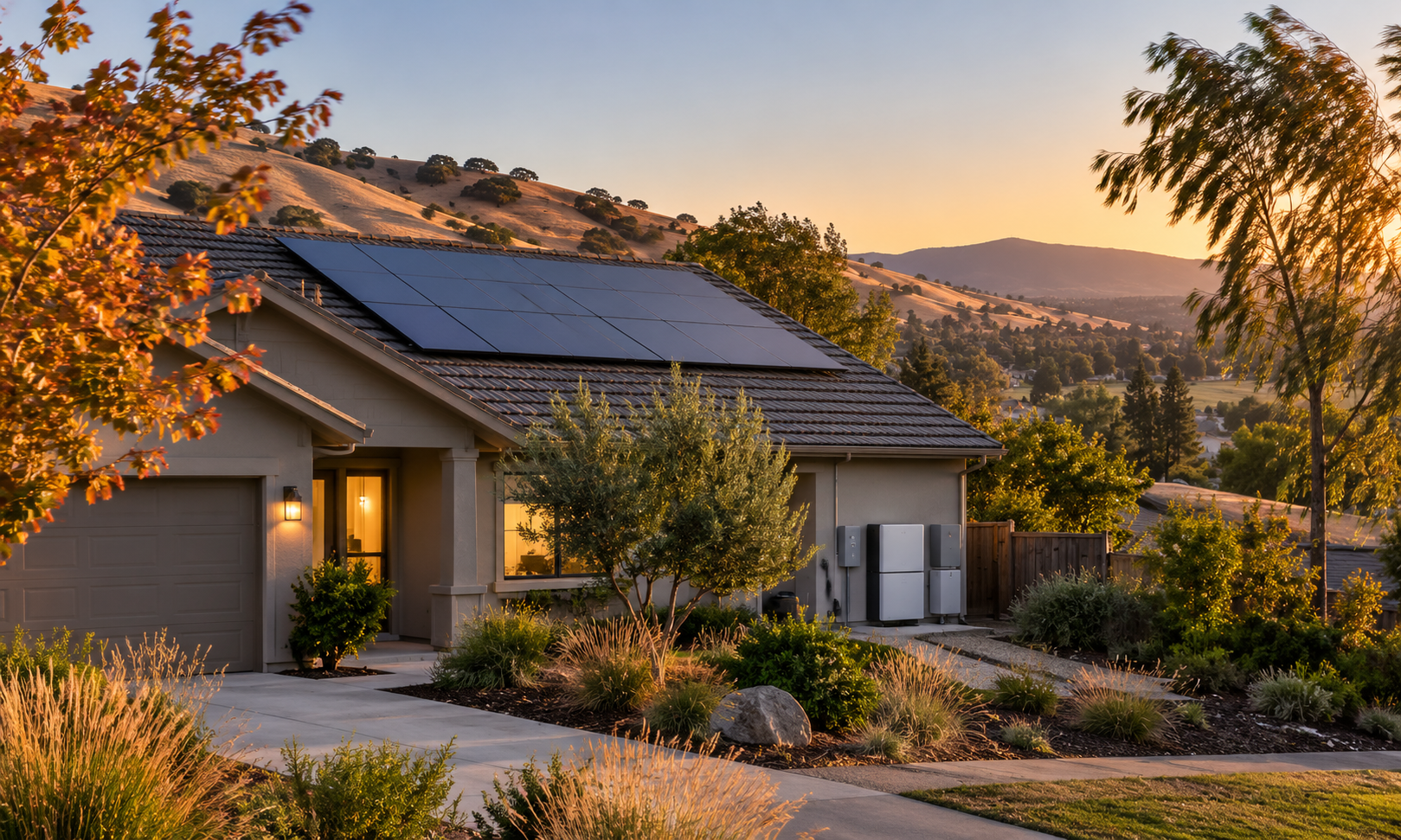
Integrating an advanced energy storage unit—such as the Tesla Powerwall—restores the fast payback periods homeowners expect from Northern California solar installations.
Here is how adding a NEM 3.0 solar battery to the Solano County array optimizes your household energy economics:
- Complete Self-Consumption: Your rooftop solar array powers your home directly throughout the morning and afternoon. Any excess power generated automatically charges your home battery instead of spilling back onto the grid for low wholesale credits.
- Peak Rate Avoidance: As sunset approaches and PG&E’s peak rate window begins, your system switches over seamlessly. Your home draws electricity directly from your battery reserve, avoiding high grid rates completely.
- Strategic Peak Export Bonuses: During specific late-summer and early-autumn evening hours when the California grid experiences extreme demand, export credit values spike significantly. Smart battery systems can automatically discharge excess stored power back to the grid during these high-value windows, earning premium bill credits.
Instead of relying on the utility grid to store your energy, your battery keeps the value right where it belongs: inside your home.
Preparing Your System Before Year-End
For homeowners planning end-of-year taxes, pairing rooftop solar with energy storage offers substantial financial incentives. Qualifying solar and battery storage installations remain eligible for the 30% Federal Investment Tax Credit (ITC), allowing you to deduct nearly one-third of the total project cost directly from your federal tax liability.
Combining the federal tax credit with local battery incentives and daily utility bill savings makes adding a battery one of the most effective home improvements for Northern California residents today.
Why Solano County Chooses Ambrose Solar
Adapting to new utility tariffs requires localized expertise and custom system engineering. Since 2013, Ambrose Solar has led the way in designing high-efficiency solar and storage solutions tailored specifically to the energy needs of Solano, Napa, Yolo, and Sacramento counties.
Our experienced team models your actual 12-month utility interval data to accurately size both your solar array and battery storage capacity. We handle every step in-house—from permitting and electrical engineering to utility interconnection and battery software setup—ensuring your system operates at peak efficiency from day one.
Don’t let changing utility rules hold back your energy independence. Contact Ambrose Solar today for a free, customized system design and discover how simple it is to thrive under NEM 3.0!